
kontakt stranica planina knives
Home Retatrutide BPC-157 + TB-500 NAD+ HGH Fragment 176-191 GHK-Cu Contact
Home Retatrutide BPC-157 + TB-500 NAD+ HGH Fragment 176-191 GHK-Cu Bacteriostatic Water Contact

NOVA LAB

What is Retatrutide?

Metabolic research insights and mechanistic overview
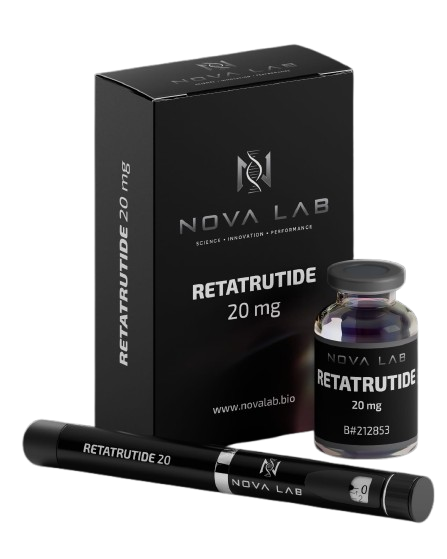
Retatrutide is a subject of modern research in the field of metabolic regulation and energy balance. It is being studied in the context of its multi-pathway activity on different hormonal systems involved in the regulation of appetite, metabolism, and energy expenditure.

Contact Us

NOVA LAB

Why is Retatrutide unique?

Understanding the biological pathways involved in metabolic regulation

Retatrutide has attracted significant scientific interest because it combines activity across three distinct receptor pathways within a single molecule. Unlike earlier approaches that focused primarily on one hormonal pathway, Retatrutide is being investigated for its ability to simultaneously engage GLP-1, GIP, and glucagon receptors. This multi-pathway approach has become an important area of research in the study of metabolism, energy balance, and hormonal regulation.

NOVA LAB

How does it work?

Understanding the biological pathways involved in metabolic regulation

Retatrutide is an investigational molecule that is being studied for its ability to interact with multiple biological signaling pathways involved in metabolic regulation. It functions as a triple receptor agonist, meaning it is designed to activate three distinct hormone receptors:

GIP Pathway

The GIP (Glucose-Dependent Insulinotropic Polypeptide) pathway is being studied for its role in metabolic regulation and energy management. Researchers continue to evaluate how this pathway may contribute to overall metabolic function.

GLP-1 Pathway

The GLP-1 (Glucagon-Like Peptide-1) pathway is associated with appetite regulation and satiety signaling. Research suggests that activation of this pathway may influence food intake and eating behavior through mechanisms involved in hunger control.

Glucagon Receptor Pathway

The glucagon receptor pathway is associated with energy expenditure and metabolic activity. Current research investigates how stimulation of this pathway may influence the body's utilization of energy resources.

NOVA LAB

Clinical research insights

Understanding observations from ongoing metabolic investigations
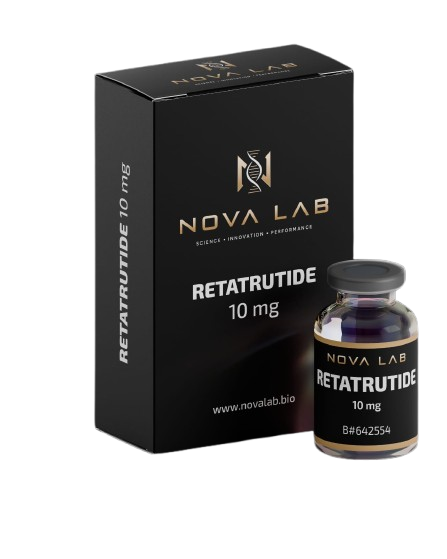
  • Appetite Regulation

    Regulation of hunger signaling and food intake.

  • Satiety Response

    Longer-lasting feeling of fullness after meals.

  • Food Intake Control

    Reduced caloric consumption observed in clinical studies.

  • Glucose Regulation

    Improved glycemic control under investigation.

  • Energy Metabolism

    Research focuses on energy expenditure and metabolic activity.

  • Body Weight Research

    Significant weight reduction reported in certain clinical trials.

NOVA LAB

Clinical development status

Structured workflow for sample analysis and information processing

Retatrutide is currently being evaluated in Phase 3 clinical research programs. Ongoing studies are investigating its safety, efficacy, and potential applications across multiple metabolic and health-related conditions.

Current research programs include investigations related to obesity, type 2 diabetes, obstructive sleep apnea (OSA), metabolic dysfunction-associated steatotic liver disease (MASLD), cardiovascular outcomes, kidney health, and chronic pain-related conditions.

As an investigational compound, Retatrutide has not yet received regulatory approval for public use.

NOVA LAB

Analysis & verification

Analytical documentation and product verification
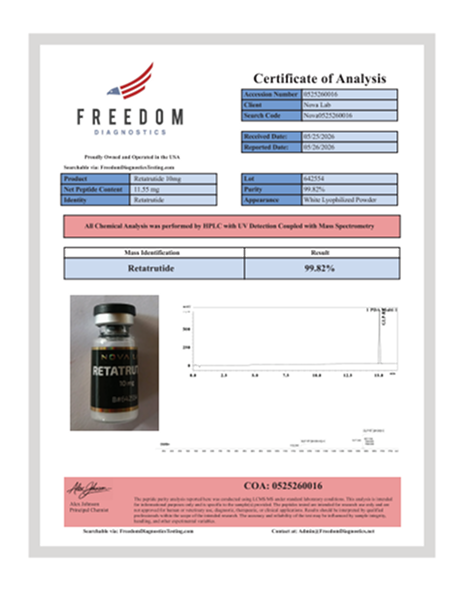
Retatrutide Certificate of Analysis

Retatrutide

Analytical documentation for Retatrutide is provided to document the reported composition and analytical characteristics of the sample.

Verify Results

The available certificate contains identification and verification information that can be reviewed against the original report.

Freedom Diagnostic Testing:

freedomdiagnosticstesting.com

NOVA LAB

Frequently asked questions

Key information about Retatrutide, its mechanisms and current clinical research

Retatrutide is an investigational once-weekly molecule being studied for its potential role in metabolic regulation. It is a triple hormone receptor agonist designed to activate the receptors for GIP (glucose-dependent insulinotropic polypeptide), GLP-1 (glucagon-like peptide-1), and glucagon.

Because it acts on three distinct hormonal pathways within a single molecule, Retatrutide has become an important subject of research in obesity, glucose metabolism, energy balance, and related metabolic conditions.
Retatrutide is being investigated as a triple receptor agonist. Its activity involves three biological signaling pathways: GIP, GLP-1, and glucagon.

GLP-1 signaling is associated with appetite regulation, satiety, and glucose-dependent insulin secretion. GIP signaling is involved in metabolic and insulin-related processes. Glucagon signaling is associated with hepatic metabolism, energy utilization, and energy expenditure.

The combination of these pathways is one of the main reasons Retatrutide is being studied as a distinct approach to metabolic regulation.
Retatrutide differs from therapies that primarily target the GLP-1 receptor because it is designed to activate three receptor pathways simultaneously: GIP, GLP-1, and glucagon.

This multi-receptor approach is being investigated to understand whether simultaneous modulation of appetite signaling, glucose regulation, and energy metabolism can produce broader metabolic effects than activation of a single pathway.
Clinical research has evaluated Retatrutide in several metabolic and obesity-related conditions.

Current and recently reported Phase 3 programs include studies involving obesity and overweight, type 2 diabetes, cardiovascular disease, obstructive sleep apnea, knee osteoarthritis pain, chronic low back pain, chronic kidney disease, and metabolic dysfunction-associated steatotic liver disease (MASLD).

These studies are designed to evaluate the potential benefits, safety, and clinical relevance of Retatrutide across different patient populations.
Clinical trials have reported substantial effects on body weight and metabolic markers in studied populations.

In Phase 3 research, Retatrutide has been associated with significant reductions in body weight and improvements in measures such as HbA1c in participants with obesity or type 2 diabetes. Additional Phase 3 studies have investigated outcomes related to cardiovascular disease, sleep apnea, knee osteoarthritis pain, and other obesity-related conditions.

Results from individual trials should be interpreted in the context of their study design, population, dose, duration, and statistical analysis. Retatrutide remains an investigational treatment and its full clinical profile is still being established.
No. Retatrutide is currently an investigational medicine and has not been approved by the FDA or other regulatory authorities for general public use.

Retatrutide is being evaluated in clinical trials to determine its safety and efficacy. Regulatory approval would require completion of the appropriate clinical development and review process.

Products sold or distributed as Retatrutide outside authorized clinical research settings should not be assumed to have the identity, purity, strength, or safety of the investigational compound.
A triple agonist is a molecule designed to activate three different receptor systems.

In the case of Retatrutide, these receptors are the GIP receptor, GLP-1 receptor, and glucagon receptor. The term describes the pharmacological mechanism of the molecule and does not represent a separate hormone or a new receptor.

The combination of these three pathways is being investigated for its potential effects on appetite, glucose metabolism, energy expenditure, and overall metabolic regulation.
No. "GLP-3" is an informal term that has appeared in media and online discussions, but it is not an established scientific classification.

Retatrutide is more accurately described as a triple hormone receptor agonist because it activates the GIP, GLP-1, and glucagon receptor pathways.
Retatrutide is currently in Phase 3 clinical development.

Multiple Phase 3 programs are evaluating its effects in obesity, type 2 diabetes, and several obesity-related complications. Results from several pivotal studies have been reported during 2025 and 2026, while additional studies remain ongoing.

According to the current development information from Eli Lilly, the company plans to submit a Biologics License Application (BLA) for Retatrutide to the U.S. FDA in the first quarter of 2027. Regulatory approval is not guaranteed and depends on the outcome of the development and review process.
Researchers are investigating several aspects of Retatrutide, including its effects on body weight, appetite regulation, glucose control, insulin-related signaling, energy expenditure, and metabolic health.

Clinical development is also examining whether the metabolic effects of Retatrutide may translate into improvements in conditions commonly associated with obesity, including cardiovascular disease, obstructive sleep apnea, knee osteoarthritis, chronic kidney disease, and MASLD.

The purpose of these studies is to establish the balance between potential benefits, tolerability, and safety across different populations and clinical settings.

The information provided on this website is intended for educational and informational purposes only. Retatrutide is an investigational medicine and has not been approved by the FDA or other regulatory authorities for general public use. The information presented here should not be interpreted as medical advice, a recommendation for treatment, or an instruction for personal use.